Is 'Clanker' a Slur? Duke Students Weigh In

Kat Johnson
Nov. 11, 2025
•
5-10 min read

Based on the title, you can probably assume that, no, I don’t think “clanker” is a slur, or I wouldn’t have written it. But why is this even a question?
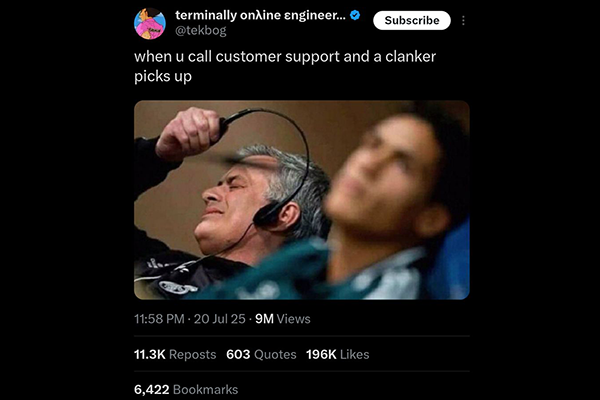
For those with less screen time than I, “clanker” is a mock insult aimed at chatbots, self-driving cars, and all sorts of technology in between. The term, and a handful of other faux “AI slurs”, have spread across TikTok and X, where users humorously vent their frustration at an increasingly automated world. But is there any hidden weight behind the joke? I asked two Duke students for their take.
Haiden Bowling, a junior political science major, sees the word as harmless fun. “I grew up watching Star Wars,” he explains. “That’s my primary association: a made-up word for a fictitious faction in a fictitious universe.”
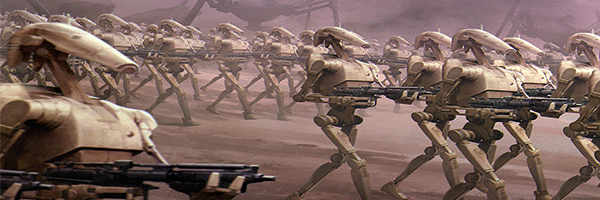
It’s true that “clanker” has its origins in the sci-fi world of Star Wars. There, it refers to droids, humanoid robots with intelligence, and, some argue, sentience. In parts of the series, the way droids are treated mirrors real-world prejudice against marginalized groups. That parallel has led some to question whether joking about “clankers” flirts with the language of real discrimination. Still, for most fans like Bowling, the term remains rooted in fiction, a relic of space battles, not social hierarchies.
Not everyone shares that casual stance. Sanoe Rapozo, a junior neuroscience major, admits she’s more cautious. “I try to refrain from using derogatory words with AI because what if they take over the world?” she laughs. According to TechRadar, she’s not alone: 70% of users report being “polite” to AI, and 12% say it’s because they fear a robot uprising. “Even if you think something doesn’t have feelings,” Rapozo adds, “it’s always good to be kind.”
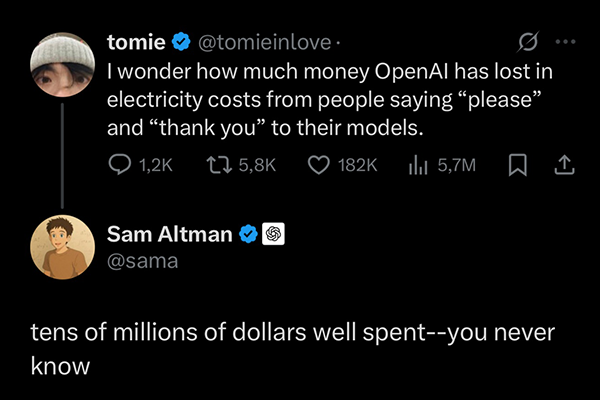
Some AI enthusiasts agree, arguing that respectful prompting leads to better, more cooperative responses. Others, however, question whether politeness is worth the cost. OpenAI CEO Sam Altman once joked that all those extra “please”s and “thank you”s add up to millions in electricity bills.
That this is even a debate shows how deeply AI has woven itself into daily life. Imagine telling your pre-Covid, pre-ChatGPT self that people are now arguing about the “proper” way to talk to their chatbot. As AI continues to advance at a near-exponential pace, we’re all being forced to reckon with its place in society: are these systems below us as tools, beside us as assistants, or above us as future overlords in waiting?
Ironically, both sides of the AI-slur and politeness debate have more in common than you might think. In trying to dehumanize machines, “AI slurs” actually humanize them. Slurs only work because they imply a shared sense of personhood, something that dogs, mice, and delivery bots don’t truly have. You can call a dog a “mutt” or a rat “vermin,” but no one calls those slurs. They sting only when we think the target could, on some level, understand the insult. So when we call a delivery bot a “clanker,” we’re not degrading it; we’re acknowledging it as something almost human.
Whether you think “clanker” is harmless fun or a symptom of deeper unease, the fact that we’re even debating it says something profound. The line between humans and machines is blurrier than ever, and maybe our words are the first to cross it.

15 Jan 2026
When change is constant and rebuilding is cheap, maybe more software should be built for …

09 Jan 2026
Principles for building with AI

19 Dec 2025
Building and shipping a real-time audio plugin with AI assistance—what helped, what didn’t, and what …